ClassifyIt: Driving Persistent Data Security
· Ralf Ulrich Garbe

 01 January 2026
ClassifyIt: Driving Persistent Data Security
Enforcing Zero Trust Through OpenTDF & ZTDF Integration
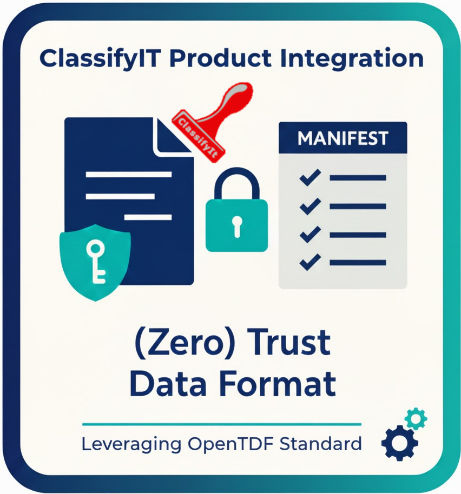
ClassifyIt is evolving from classification and labeling into a core engine for cryptographically enforced data protection. By integrating OpenTDF (Zero Trust Data Format), ClassifyIt brings persistent, policy-bound security directly into the data layer.
Why OpenTDF & ZTDF?
Traditional perimeter security fails once data leaves the system. OpenTDF and ZTDF solve this by embedding protection directly into the file itself—independent of storage, transport, or location:
- Interoperability: No vendor lock-in
- Access policies: Rules stay embedded in the file
- Cryptographic protection: Security is tied to the data
- Zero-Trust enforcement: Embedded directly into the file
Security-First Implementation
The implementation in ClassifyIt follows modern, high-assurance cryptographic standards from day one:
- ECDH (Elliptic Curve Diffie-Hellman) - Secure key exchange with strong forward secrecy
- AES-256-GCM - Authenticated encryption for confidentiality and integrity
- Per-object Data Encryption Keys (DEK) - Never reused, never exposed
- Zero Trust by design - No implicit trust in users, systems, or networks
- (later) Policy-controlled key release - Keys are only released after ABAC policy evaluation, with a Key Management System
- (current) Local Elliptic Curve Certificate support - exchange through standard PEM files
What This Enables
- Persistent protection of documents and data
- Cryptographically enforced access control
- Interoperability with OpenTDF-compliant ecosystems
- Alignment with Zero Trust architectures (ZTNA / ABAC)
- A future-proof foundation for regulated and classified environments
Status
Active implementation in progress. The focus is correctness, interoperability, and cryptographic robustness—before features and UI polish.