Sum of Quadratic Numbers
Sum of the First Quadratic Numbers
or The Pyramidal Number
Introduction
What is the sum of the first n quadratic numbers? Fascinated by the simple method for calculating the sum of the first natural numbers, I investigated whether there was an equally elegant method for square numbers. At the time, I could not find a solution as simple and elegant as Carl Friedrich Gauss’s method for natural numbers. However, I found a logical, easy-to-follow approach that also works for sums of higher powers.
=
What is the problem?
What is the result of the following expression: 12 + 22 + 32 + 42 + 52
Well, just calculate it and you know: 1 + 4 + 9 + 16 + 25 = 55
That was easy, but what is the result of this expression? 12 + 22 + 32 + 42 + 52 + ... + n2
You could calculate it with a simple computer program, or look for a formula that works for all n and is faster to evaluate. This article explores the latter approach.
The mathematical question is the following: 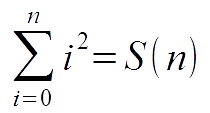
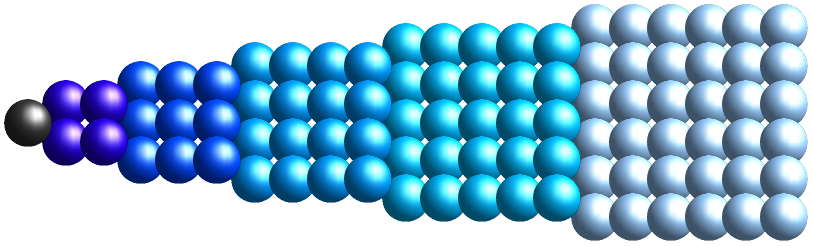
In graphical terms it looks like this:
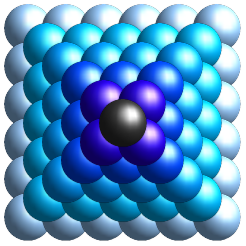
and you can stack them to a pyramid:
What is the solution?
The formula for the problem is: 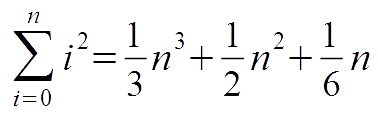
Finding the solution: the quick way
An internet search shows that many people have considered this problem and found different ways to reach the result. One approach is described here: http://www.arndt-bruenner.de/mathe/Allgemein/summenformel1.htm
The approach I took started similarly to the approach in the link above, however I found another useful observation. Having assumed that there is an existing formula for the sum, the slope of that function must be quadratic so the function we are looking for must be cubic. So we know that the formula has this structure: 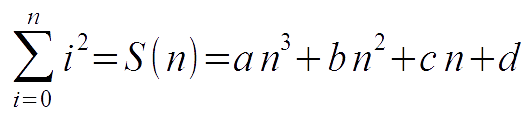
Four equations determine the coefficients (e.g. set n=0, we find out that d=0 - with n=1, n=2, and n=3 we get a system of linear equations that gives a=1/3, b=1/2, and c=1/6).
The next step
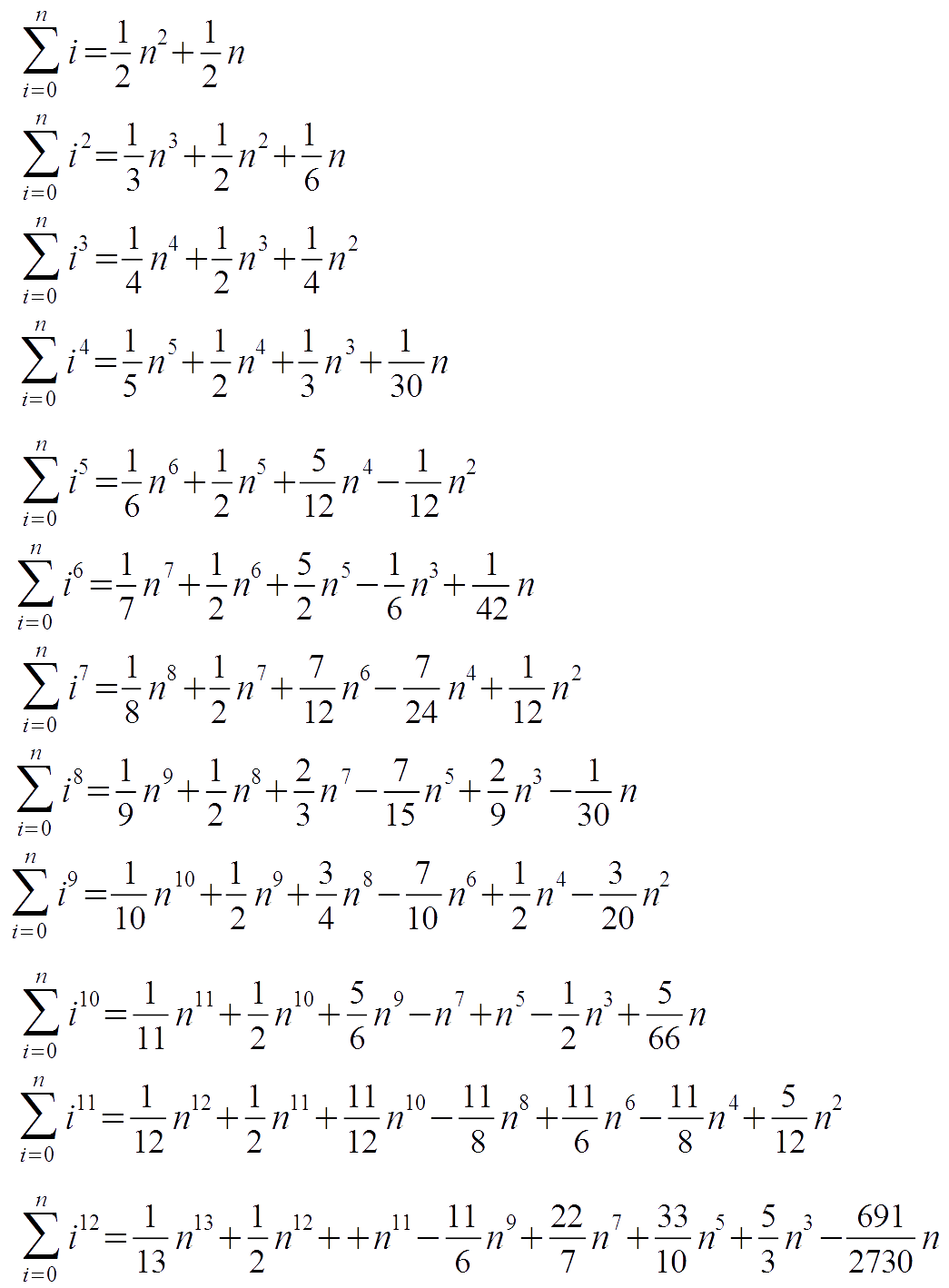
Using the same method, we can find formulas for sums of higher powers.
Sum of cubic numbers: 
List of sums of higher order:
Original article content, with grammar and spelling edited for readability. Illustrations and downloads are retained. Source page ↗